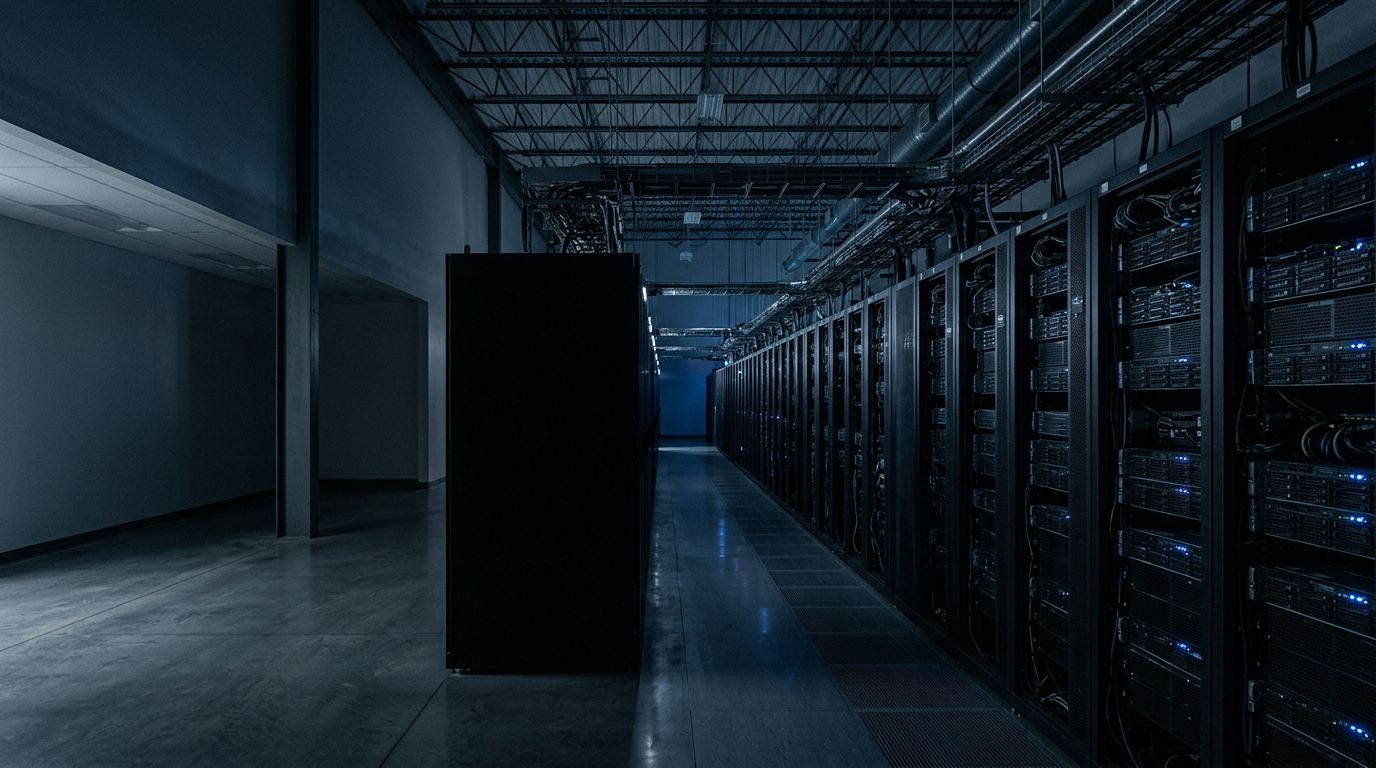
For two years the market expected GPU prices to fall. They haven't. Where compute actually stands as 2026 closes: prices, supply, contracts, and what it means for anyone with an expansion plan.
Every technology cycle has a moment when the old rules stop working. For GPUs, the rules were supposed to be simple: new generations arrive, supply catches up, older hardware gets cheaper and prices drift down. That is how semiconductors have behaved for decades.
2026 broke that pattern.
Prices went the wrong way
At the start of the year, the consensus was that rental prices had peaked. Instead, they climbed. getdeploying, which tracks 16 providers with priced B300 offers, put the median on-demand rate at $9.50 per GPU-hour on 8 November, about 14% higher than 90 days earlier. Nebius's public list price for the B300 is the same, $9.50.
The more striking signal comes from the back of the market. On its third-quarter earnings call, NVIDIA said rental prices for the H100, a GPU launched in 2022, had risen about 20% this year, and A100 prices about 15%. Hardware that should be ageing out is earning more than it did a year ago. That only happens when demand is outrunning everything the industry can build.
Even the largest buyers are short
If any company can buy its way out of a shortage, it's Microsoft. Yet Microsoft told investors it expected to be capacity-constrained through at least the end of its fiscal year, with demand exceeding its infrastructure build-out and costing it Azure revenue. It has since doubled its data-centre capacity in two years, and says it expects constraints to continue.
When the world's largest cloud is rationing capacity, everyone further down the queue feels it. Hyperscalers, frontier labs and committed enterprise buyers absorb the newest clusters through long forward contracts, and what reaches the open market is what's left.
Demand has changed shape
The first wave of AI demand was training: large, periodic jobs. The wave now arriving is inference, the work of running models in production for customers, around the clock. Gartner expects global spending on inference ($23.3bn) to overtake training ($19bn) in 2026, and forecasts AI-optimised infrastructure-as-a-service spending to reach $42bn this year and $66bn in 2027.
Inference is a different kind of demand. It doesn't finish. Agentic AI, where models run multi-step tasks on their own, multiplies the compute each user consumes. For enterprises, that turns GPU capacity from a project expense into permanent operating infrastructure, and it makes planning capacity a board-level question.
Most capacity is sold before anyone sees it
The headline on-demand rate is not where the real market clears. AIMultiple's index put the reserved B300 median at $5.02 per GPU-hour in early November, against $9.32 on demand. The buyers paying close to half the on-demand rate are the ones who knew where to look, committed to a term and paid upfront.
That is where most of the volume trades: privately, bilaterally, before it reaches a public price list. As early as March, SemiAnalysis reported that all capacity coming online until August or September 2026 had already been booked. Boston Consulting Group describes a market of heterogeneous contracts and opaque pricing. By the time capacity is advertised, it has usually been offered to someone else first.
On the NodusX board today, reserved B300 capacity is quoted at indicative rates of about $4.25 to $5.60 per GPU-hour, on three- to five-year terms with 25% to 30% paid upfront.
The shortage has spread down the supply chain
It isn't only GPUs. TrendForce's AI-server radar for 2 November rates six of the seven components it tracks as short of supply, with ABF substrates quoted at 48 to 56 weeks. On the same day it moved GPUs from "Balanced" to "Tightening". Server makers are already racing to secure 2027 supply of basic parts.
The next generation won't release the pressure soon. NVIDIA says Vera Rubin racks have been shipping in volume since August and are already in production at hyperscalers and leading neoclouds. The first waves are spoken for. For most buyers in 2027, the system they can actually sign for is Blackwell: B300 and GB300.
Money has followed the shortage
Capital has noticed. Bloomberg counts more than $400bn of AI-related debt raised globally in 2026. GPU-backed loans, once priced like venture debt, now reach investment grade. Long contracts have become the norm: Lambda reportedly signed a $35bn capacity agreement with Anthropic this autumn. The largest buyers are locking in years of supply, and everyone else competes for what's left.
A fair caveat
Shortage isn't the only thing slowing AI projects. In VentureBeat's October survey, 38% of organisations had delayed, scaled back or cancelled an AI project because it cost more than planned, against 12% citing a shortage of capacity. The same research found most enterprise GPUs running at half capacity or less. Price and planning matter as much as availability. That is exactly why the terms you contract on, not just whether you can find GPUs, decide whether an AI programme pays back.
What this means if you have an expansion plan
- Waiting has a cost. If a workload needs capacity in the first half of 2027, the question isn't whether prices will fall. It's which blocks are still uncommitted, and on what terms.
- Reserved beats on-demand. The spread between reserved and on-demand pricing is close to 2x. Buyers who can commit to term and prepayment secure the lower rate and a committed RFS date.
- Visibility is the edge. The best-specified capacity rarely reaches a public price list. The buyers who win see it first and can contract quickly.
- For owners of capacity, the opportunity is real, but it depends on turning capacity into a contract with a creditworthy counterparty. Term, prepayment and counterparty decide what the capacity is worth.
Compute has become the constraint on AI. In a market this tight, the scarcest thing isn't the GPU. It's knowing where the GPU is.
Sources
- getdeploying, NVIDIA B300 cloud GPU pricing (8 Nov 2026)
- AIMultiple, Cloud GPU Rental Price Index (Nov 2026)
- FourWeekMBA, GPU price pages at Nebius, Lambda and CoreWeave (18 Nov 2026)
- Yahoo Finance, NVIDIA CFO on H100 and A100 rental prices
- Microsoft Q1 FY26 earnings call transcript
- Directions on Microsoft, capacity constraints to continue (30 Jul 2026)
- Gartner, AI-optimised IaaS spending forecast (10 Aug 2026)
- SemiAnalysis, The Great GPU Shortage
- BCG, Understanding the new economics of AI compute markets (2026)
- FourWeekMBA, TrendForce AI-server component radar (2 Nov 2026)
- TechNews, NVIDIA Q3 earnings call on Vera Rubin (18 Nov 2026)
- The Next Web, AI debt raised in 2026 (28 Aug 2026)
- DCD, Lambda private debt and Anthropic agreement
- VentureBeat Pulse, AI Infrastructure and Compute Report (Oct 2026)
General information only, not investment, financial or technical advice. Figures are drawn from the sources listed and may change; illustrative assumptions are labelled as such.