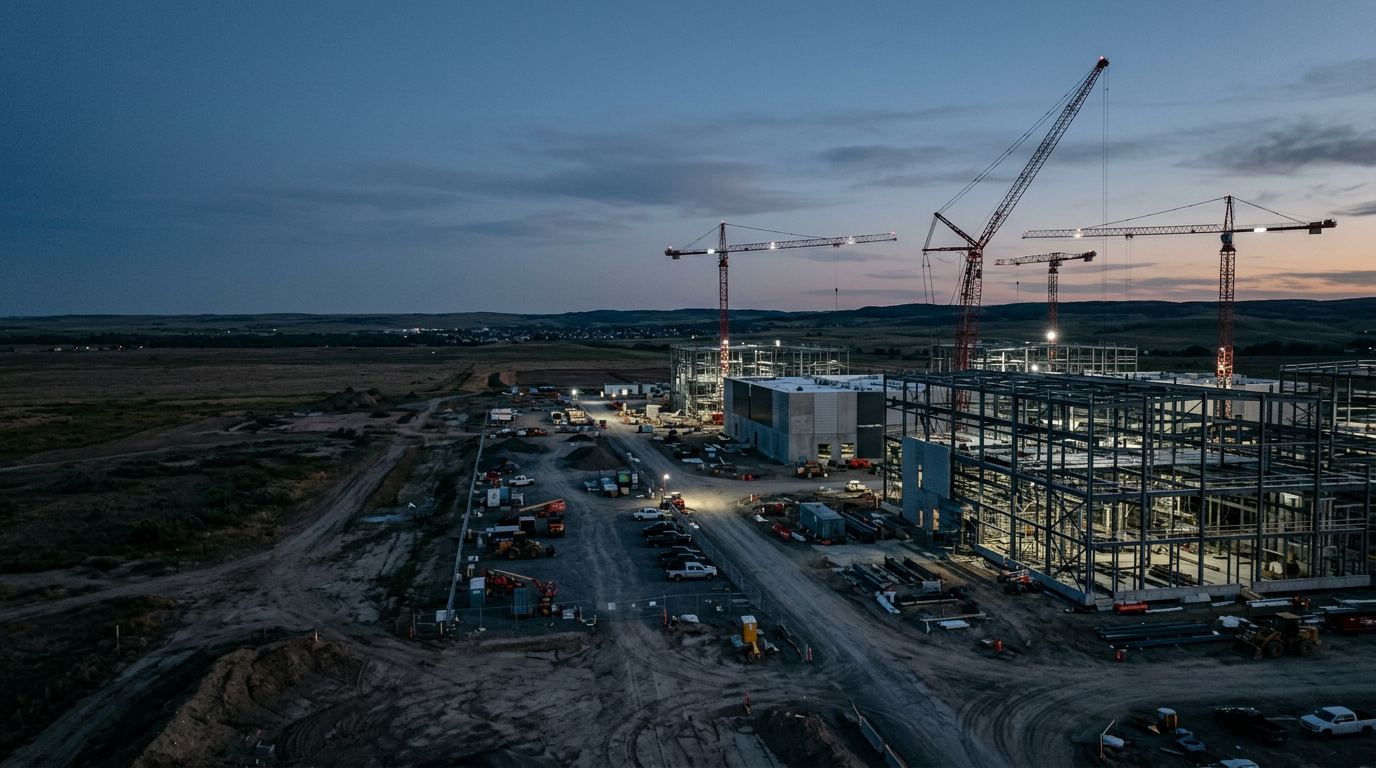
A cluster of 512 GPUs costs tens of millions of dollars before it earns a cent. Three years ago, almost nobody would lend against one. Today it's an investment-grade asset class. How the structures work, and why the customer contract matters as much as the hardware.
When the first large GPU loans were written, there was no template. Lenders were being asked to accept, as collateral, a chip that might be superseded within two years, in an industry whose demand curve nobody could model. The early deals were priced accordingly, at a reported 11% to 14% all-in.
Three years later, the same asset class reaches investment grade. What changed wasn't the hardware. It was the structure around it.
Why financing now decides who gets capacity
In a market where GPUs are sold before they ship, the buyer who can sign a three-year contract with a deposit wins the block. For operators, financing is what turns a signed contract into delivered capacity. For enterprises, understanding how the operator is financed explains why term, prepayment and credit matter so much in every negotiation.
The structure that made it work
Most GPU financings follow the same pattern:
- 1.A ring-fenced company (an SPV) owns the hardware for one deployment: the GPU servers and related infrastructure.
- 2.The customer contract is assigned to it. The multi-year capacity agreement with the end customer sits in the same vehicle.
- 3.The lender lends against both. The loan is secured on the hardware and repaid from the contract's cash flows.
- 4.The debt runs ahead of depreciation. Repayments are sized so the loan falls faster than the value of the GPUs.
The insight is simple. The lender isn't really betting on the GPU. It's betting on the customer's willingness to keep paying for it.
What the market looks like now
- Lambda closed a $926m senior secured term loan in September, priced at SOFR + 3.00% and rated Baa2 by Moody's, secured by the GPU servers it funds and their cash flows.
- Nebius raised $775m of secured debt at SOFR + 2.50% from a bank group led by MUFG.
- Australia's Sharon AI entered a GPU-backed SPV facility at a fixed 9.95%.
Wing VC estimates that more than $20bn of GPU-backed facilities have been announced.
What a lender asks
- Who is paying? A contract with an investment-grade buyer is financed on very different terms from one with an early-stage start-up.
- For how long? Contracted years compared with the useful life of the hardware. Three to five years is the norm for Blackwell-generation systems.
- How much upfront? Prepayments reduce the debt needed and show the buyer is committed.
- What's left at the end? The likely value of the GPUs when the contract ends.
- Can it be delivered? Power, cooling, insurance and the operator's track record of bringing capacity online on time.
A worked example (illustrative)
Take 64 HGX B300 nodes (512 GPUs), contracted for three years at $5.00 per GPU-hour.
| Item | Value |
|---|---|
| Annual contract value (512 × $5.00 × 8,760 hours) | About $22.4m |
| Three-year contract value | About $67.3m |
| 25% prepayment, received upfront | About $16.8m |
A lender sizes the loan against the remaining contracted cash flow, the buyer's credit and the expected value of the hardware. These figures are illustrative, not a quote.
Other routes
- Operating and finance leases: a lessor buys the equipment and leases it to the operator. This keeps the operator's capital free but costs more over the term.
- Vendor financing: some server makers and distributors offer deferred payment on large orders.
- Delayed-draw facilities: the operator draws funds as each tranche of capacity is delivered and contracted.
- Power equipment: gas gensets and turbines are financed along similar lines, with lenders looking for a long-term power or capacity agreement behind the asset.
The lesson for anyone building capacity: the contract is the asset. A strong offtake turns hardware into something a lender will finance.
Nodus introduces operators and owners of capacity to lenders and investors who finance this kind of equipment. We do not lend or arrange debt ourselves.
Sources
- Wing VC, How the GPU Became Collateral (Sep 2026)
- StorageNewsletter, Lambda closes $926m term loan B (22 Sep 2026)
- DCD, Lambda raises $926m senior secured loan facility
- DCD, Sharon AI and Lambda secure GPU-backed debt funding
General information only, not investment, financial or technical advice. Figures are drawn from the sources listed and may change; illustrative assumptions are labelled as such.